pHAb Reactive Dyes
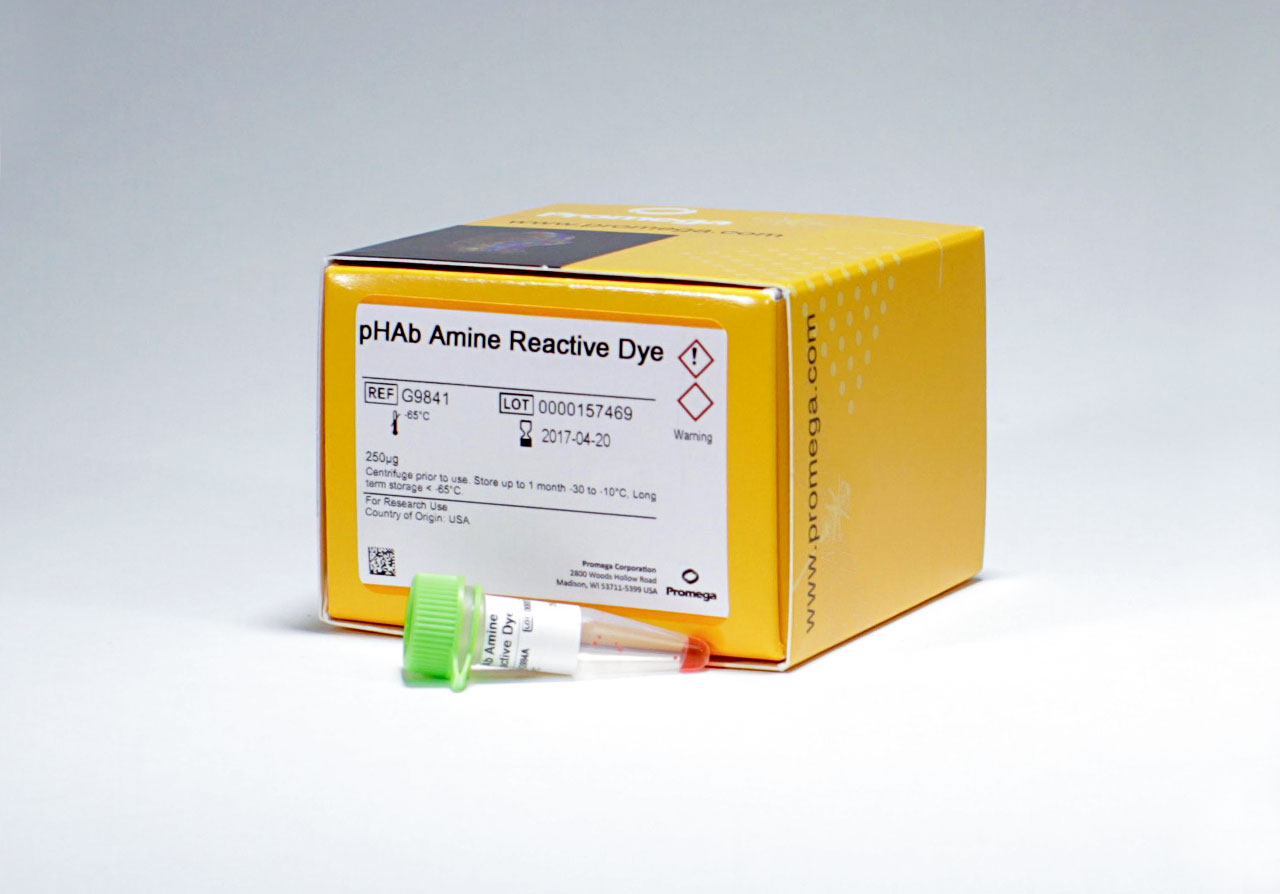
Measure Antibody Internalization in Real Time
- Compatible with 96-well, plate-based assay
- High signal-to-background ratios
- On-bead conjugation
Catalog Number:
Choose a conjugation option
Size
Catalog Number: G9841
Catalog Number: G9831
Catalog Number: G9835
Catalog Number: G9845
Screen for Antibody Internalization
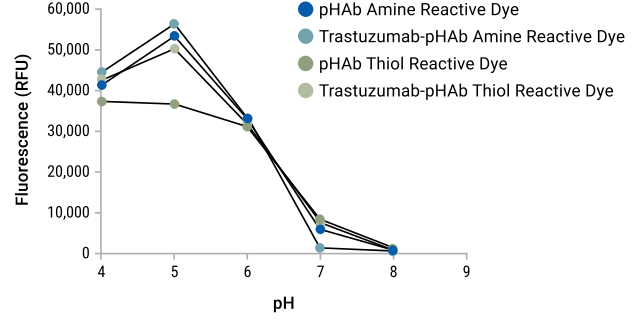
pHAb Dyes are pH sensor dyes that have very low fluorescence at pH > 7 and a dramatic increase in fluorescence as the pH of the solution becomes acidic. pHAb Dyes have excitation maxima (Ex) at 532nm and emission maxima (Em) at 560nm.
pHAb Reactive Dyes are designed specifically for antibody labeling and can be used for high-throughput antibody internalization screening assays.
Development of a Novel Anti-CD19 Antibody-Drug Conjugate
B-cell lymphoma is a cancer in need of a therapy. Patients with B-cell lymphoma often respond to first line therapies, but tumor recurrence rate is high and prognosis often poor. Novel approaches to B-cell lymphoma treatment are needed.
CD19 is a B-cell transmembrane glycoprotein that plays a key role in B-cell malignancies and autoimmune diseases and is a target of interest for new B-cell lymphoma therapies. Of the anti-CD19 therapies in development and/or clinical trials, antibody-drug conjugates (ADCs) are some of the most promising, as they are both specific and toxic. In the ADC mechanism of action, the antibody binds CD19 on the B-cell surface stimulating internalization of the antibody-receptor complex. Upon internalization toxin is released, killing the tumor cell.
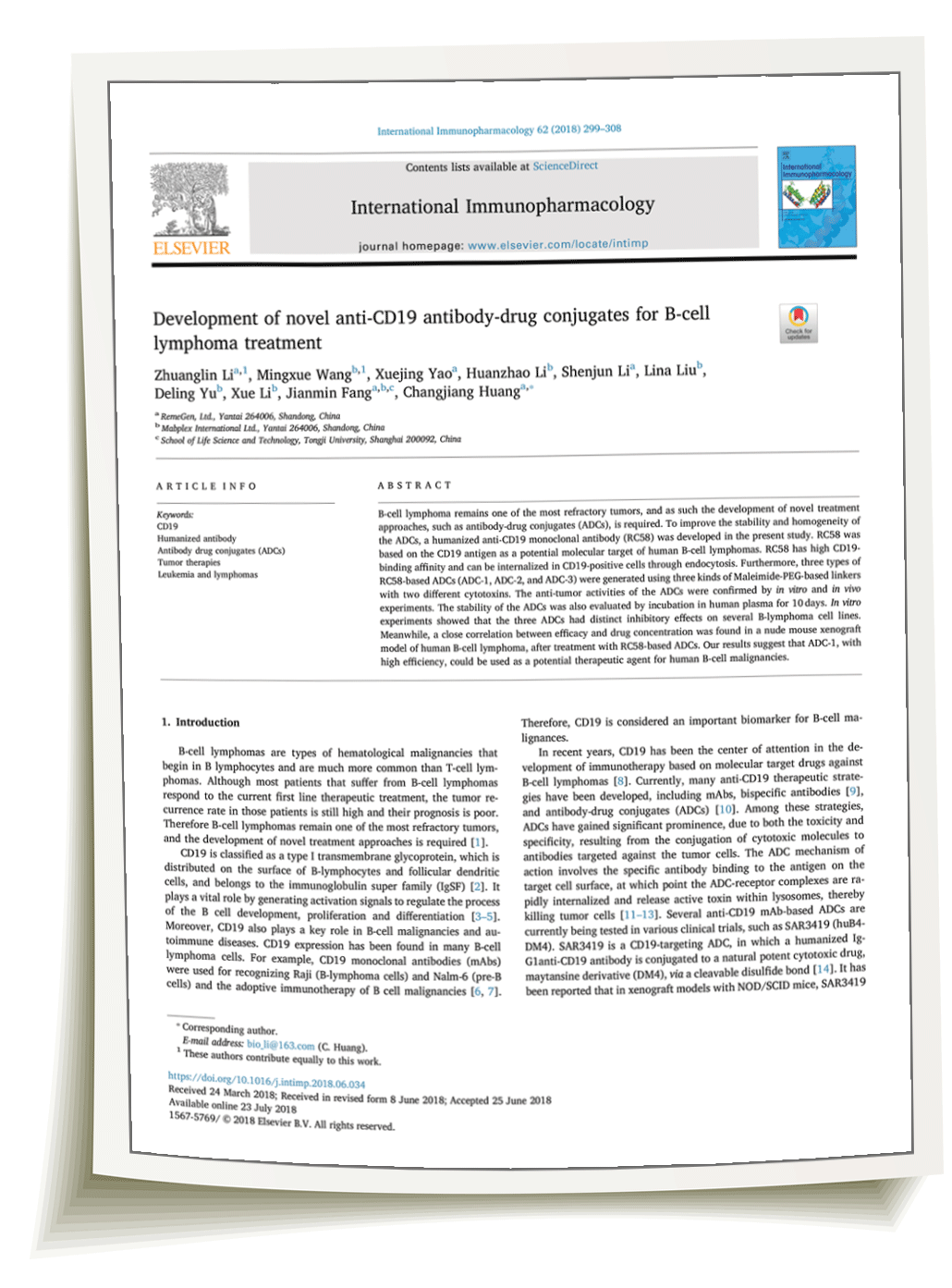
In this work, Li et al. created a novel CD19-binding monoclonal antibody, RC58 . They used pHAb Amine Reactive dyes to analyze internalization of the RC58 antibody.
Details of their work can be found in this 2018 International Immunopharmacology paper: "Development of novel anti-CD19 antibody-drug conjugates for B-cell lymphoma treatment".
pHAb Amine Reactive Dye
pHAb Reactive Dyes are available in two reactive forms suitable for antibody conjugation: pHAb Amine Reactive Dye and pHAb Thiol Reactive Dye.
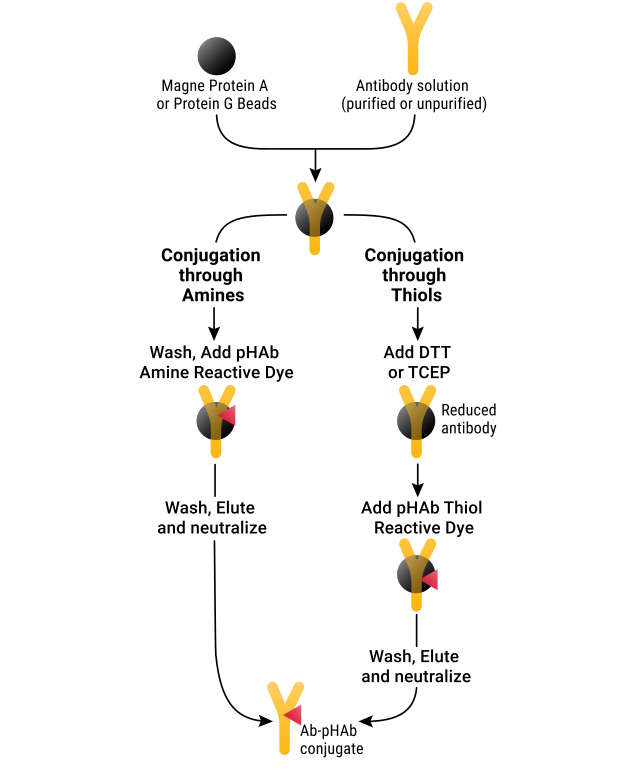
pHAb Amine Reactive Dye has a succinimidyl ester group that reacts with primary amines available on the lysine amino acids on the antibodies.

pHAb Thiol Reactive Dye
pHAb Thiol Reactive Dye has a maleimide group that reacts with thiols. This maleimide group is conjugated to the antibody after the cysteine disulfide bonds in the hinge region of the antibody are reduced to thiols through the use of a reducing agent, such as DTT or TCEP. pHAb Reactive Dyes retain their fluorescent response to decreases in pH even after conjugation to antibody.

Monitor Antibody Internalization
A key feature of pHAb Dyes is that they have two sulfonate groups per dye, which increases solubility and reduces the aggregation often seen with other non-sulfonated dyes. pHAb Dyes maintain their fluorescence response to pH change even after antibody conjugation.
Even though antibody conjugation is the key application, any protein containing primary amines on lysine amino acids or thiols on cysteine amino acids can be conjugated with pHAb Dyes.
Two Options for Conjugation of pHAb Reactive Dyes to Antibodies
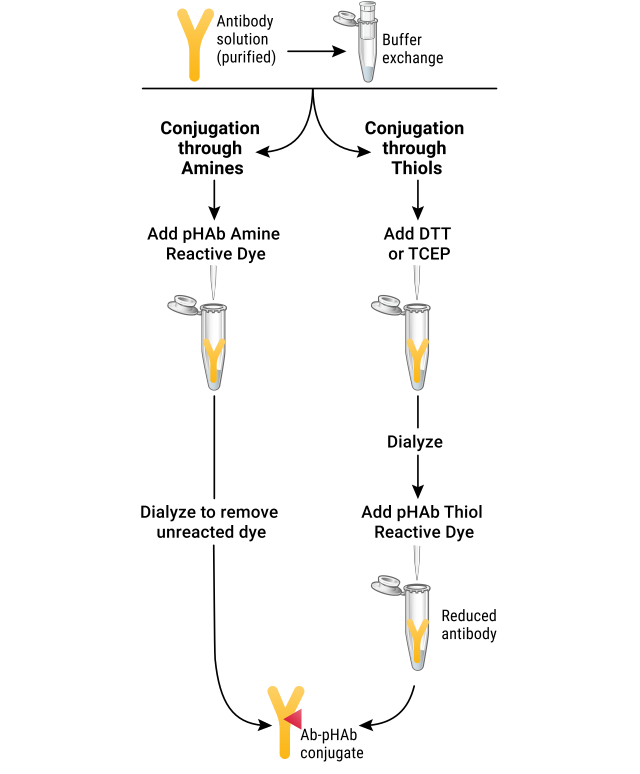
There are two workflow options for conjugation of pHAb Reactive Dyes to antibodies: traditional solution-based conjugation or on-bead conjugation.
Traditional In-Solution Conjugation of Antibody
On-Bead Conjugation of Antibody
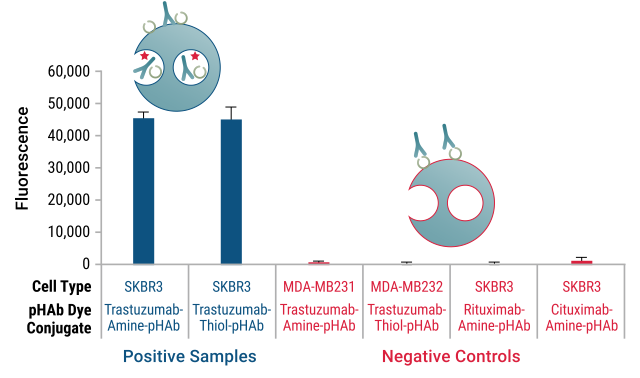
pHAb Reactive Dyes Retain Fluorescent Response to pH after Conjugation
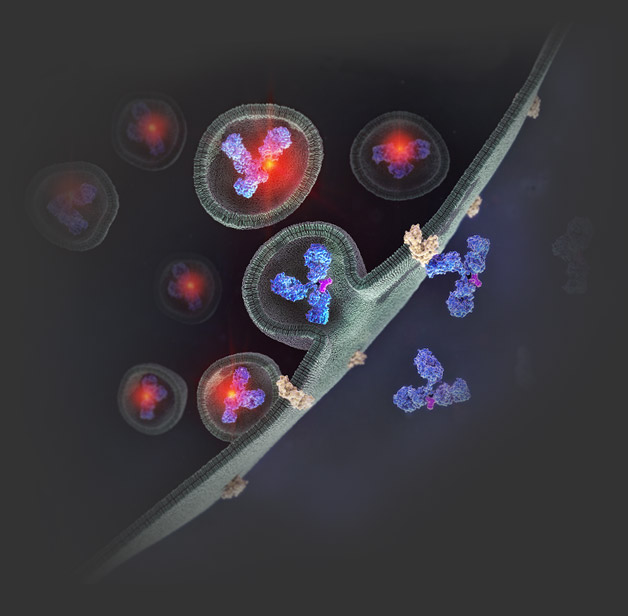
pHAb Dye-conjugated antibodies can be used for monitoring receptor-mediated antibody internalization. When an antibody-pHAb Dye conjugate binds to its receptor on the cell membrane, it exhibits minimal fluorescence. However, upon receptor-mediated internalization, antibody-pHAb Dye conjugates traffic to the endosome and lysosomal vesicles where pH is acidic, causing the pHAb Dye to fluoresce. This fluorescence can be detected using various techniques, including cell imaging, flow cytometry and fluorescent plate-based readers with appropriate filters.
Protocols
Complete Protocol
Specifications
Catalog Number:
What's in the box?
| Item | Part # | Size |
|---|---|---|
pHAb Amine Reactive Dye |
G984A | 1 × 250μg |
SDS
Search for SDSCertificate of Analysis
Use Restrictions
For Research Use Only. Not for Use in Diagnostic Procedures.Storage Conditions
What's in the box?
| Item | Part # | Size |
|---|---|---|
pHAb Thiol Reactive Dye |
G983A | 1 × 250μg |
SDS
Search for SDSCertificate of Analysis
Use Restrictions
For Research Use Only. Not for Use in Diagnostic Procedures.Storage Conditions
What's in the box?
| Item | Part # | Size |
|---|---|---|
pHAb Thiol Reactive Dye |
G983A | 4 × 250μg |
SDS
Search for SDSCertificate of Analysis
Use Restrictions
For Research Use Only. Not for Use in Diagnostic Procedures.Storage Conditions
What's in the box?
| Item | Part # | Size |
|---|---|---|
pHAb Amine Reactive Dye |
G984A | 4 × 250μg |
SDS
Search for SDSCertificate of Analysis
Use Restrictions
For Research Use Only. Not for Use in Diagnostic Procedures.Storage Conditions
Resources
No related resources available
Related Products
Frequently Used With
Magne® Protein G and Magne® Protein A Beads
Magnetic affinity beads with Protein A or G for Ab purification from culture media, ascites and serum samples.
G7471, G7472, G7473, G8781, G8782, G8783
ADCC Reporter Bioassay, V Variant
Measure potency and stability of antibodies mediating ADCC through the high-affinity human FcγRIIIa-V receptor.
G7015, G7014, G7010, G7016, G7013, G7018, G7102, GA1130
PD-1/PD-L1 Blockade Bioassay
Measure the ability of biologics to block immune checkpoint signals
J1250, J1255, J1252, J1191, J1195, J1201
CellTiter-Glo® Luminescent Cell Viability Assay
Determine the number of viable cells in culture based on quantitation of ATP present.
G7570, G7571, G7572, G7573