GSH/GSSG-Glo™ Assay


A Luminescent-Based Assay to Detect and Quantify Total Glutathione Ratios
- Measures physiologically relevant GSH/GSSG ratios
- Simple protocol minimizes sample handling, reducing variability
- Stable assay signal amenable to high throughput analysis

Catalog Number:
Size
Catalog Number: V6611
Catalog Number: V6612
Valuable Measurement of Glutathione (GSH-to-GSSG) Ratios
The GSH/GSSG-Glo™ Assay is a luminescence-based system that detects and quantifies total glutathione (GSH + GSSG), GSSG and GSH-to-GSSG ratios in cultured cells. Reduced glutathione (GSH) and oxidized glutathione (GSSG) both exist in healthy cells, the majority of which is in reduced (GSH) form. A change in GSH and GSSG levels are important when assessing toxicological responses and an indicator of oxidative stress, potentially leading to apoptosis or cell death. The GSH and GSSG detection assay provides a simple, rapid multiwell-plate format where stable luminescent signals are correlated with either the total GSH or the GSSG concentration of a sample directly in culture wells.
Both total glutathione and GSSG determinations are based on the reaction where GSH-dependent conversion of a GSH probe, Luciferin-NT, to luciferin by a glutathione-S-transferase enzyme is coupled to a firefly luciferase reaction. Light from luciferase is dependent on the amount of luciferin formed, which is in turn dependent on the amount of GSH present. This makes the luminescent signal proportional to the amount of GSH. Determining the total glutathione and amount of GSSG are performed in parallel reactions. In one configuration, the assay reagents measure total glutathione using a reducing agent that converts all the glutathione, GSH and GSSG in a cell lysate to the reduced form, GSH. In a second configuration, the assay reagents are used to measure only the oxidized form, GSSG. In this case, a reagent is added that blocks all the GSH while leaving the GSSG intact. This blocking step is followed by a reducing step that converts the GSSG to GSH for quantification in the luminescent reaction. Because the assays are performed directly on cells in culture wells, loss of GSH or GSSG is minimized, reducing variability.
GSH/GSSG Ratio Determination in Different Cell Lines
| Cell Line | Cells/Well | Ratio GSH/GSSG | |
|---|---|---|---|
| Vehicle | Menadione | ||
| HeLa | 5,000 | 63.8 | 2.2 |
| HepG2 | 10,000 | 92.6 | 2.2 |
| HepaRG® | 50,000 | 35.3 | 2.5 |
| A549 | 5,000 | 87.9 | 10.9 |
| Rat hepatocytes | 50,000 | 19.8 | 1.1 |
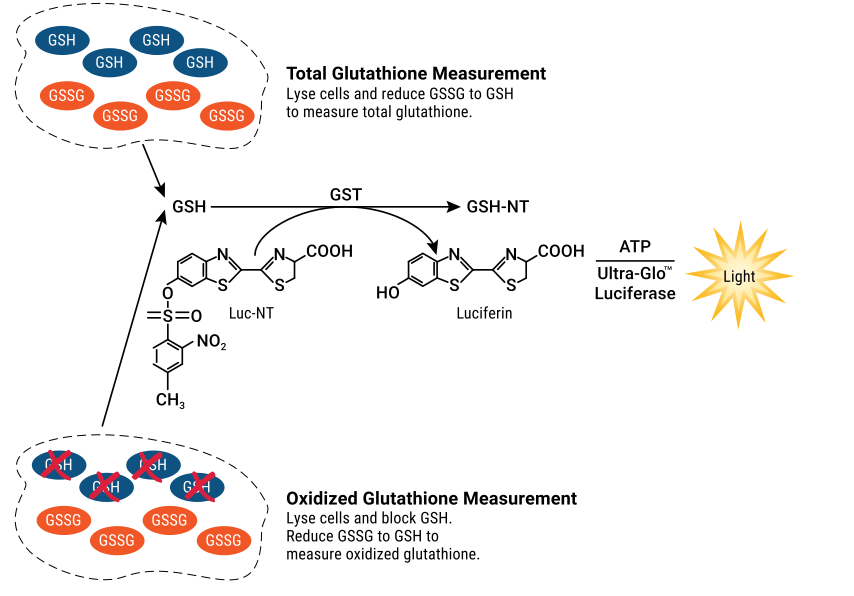
The GSH/GSSG-Glo™ Assay. GSH-dependent conversion of a GSH probe, Luciferin-NT, to luciferin by a glutathione S-transferase enzyme is coupled to a firefly luciferase reaction.
Limit of Detection Using Reduced (GSH) and Oxidized (GSSG) Glutathione


GSH (Panel A) and GSSG (Panel B) standards were assayed in a 96-well plate using the GSH/GSSG-Glo™ Assay and a GloMax® Luminometer. The results were averaged and plotted on the graphs above. A linear trend line was generated and correlation coefficients calculated for the fit of the data to the trend line. Limits of detection were 2.5nM GSH and 0.5nM GSSG.
Protocols
Complete Protocol
Specifications
Catalog Number:
Contenido
| Item | Part # | Presentación | Concentración | Available Separately |
|---|---|---|---|---|
|
Passive Lysis Buffer, 5X |
E194B | 1 × 1ml | View Product | |
|
DTT |
P117B | 1 × 250μl | 100mM | View Product |
Reconstitution Buffer with Esterase |
V144A | 1 × 10ml | ||
|
Glutathione Reaction Buffer |
V163A | 1 × 10ml | ||
|
NEM, 25mM |
V164A | 1 × 50μl | ||
|
Luciferin-NT |
V687A | 1 × 100μl | ||
|
Glutathione S-Transferase |
V689B | 1 × 500μl | ||
|
Glutathione, 5mM |
V690A | 1 × 100μl | ||
|
Luciferin Detection Reagent |
V859A | 1 × 1 each |
SDS
Search for SDSCertificado de Análisis
Use Restrictions
For Research Use Only. Not for Use in Diagnostic Procedures.Condiciones de Almacenaje
Contenido
| Item | Part # | Presentación | Concentración | Available Separately |
|---|---|---|---|---|
|
Passive Lysis Buffer, 5X |
E194C | 1 × 5ml | View Product | |
|
DTT |
P117C | 1 × 1.25ml | 100mM | View Product |
Reconstitution Buffer with Esterase |
V144B | 1 × 50ml | ||
|
Glutathione Reaction Buffer |
V163B | 1 × 50ml | ||
|
NEM, 25mM |
V164B | 1 × 250μl | ||
|
Luciferin-NT |
V687B | 1 × 500μl | ||
|
Glutathione S-Transferase |
V689B | 3 × 500μl | ||
|
Glutathione, 5mM |
V690A | 2 × 100μl | ||
|
Luciferin Detection Reagent |
V859B | 1 × 1 each |
SDS
Search for SDSCertificado de Análisis
Use Restrictions
For Research Use Only. Not for Use in Diagnostic Procedures.Condiciones de Almacenaje
Resources
No related resources available
Related Products
Productos Similares
GSH-Glo™ Glutathione Assay
Ensayo homogéneo y bioluminiscente para medir el glutatión.
V6911, V6912
Mitochondrial ToxGlo™ Assay
Un ensayo eficaz para predecir la posible disfunción mitocondrial.
G8000, G8001
ROS-Glo™ H2O2 Assay
Ensayo bioluminiscente sensible que mide el nivel de H2O2 en cultivos celulares.
G8820, G8821
Usado con frecuencia junto con
ApoLive-Glo™ Multiplex Assay
Mida la viabilidad y la actividad de la caspasa-3/7 de forma simultánea para confirmar los mecanismos de muerte celular.
G6410, G6411
CytoTox-Glo™ Cytotoxicity Assay
Ensayo de citotoxicidad basado en luminiscencia, de alta sensibilidad que mide el número relativo de células muertas.
G9290, G9291, G9292
MultiTox-Fluor Multiplex Cytotoxicity Assay
Ensayo fluorescente de un solo reactivo que le permite medir el número de células vivas y muertas en las placas de cultivo.
G9200, G9201, G9202
Caspase-Glo® 3/7 Assay System
Ensayo luminiscente fácil de usar que permite detectar la actividad de la caspasa-3/7.
G8090, G8091, G8093, G8092