ROS-Glo™ H2O2 Assay


Specific, Direct Detection of Hydrogen Peroxide (H<sub>2</sub>O<sub>2</sub>)
- Fast assay involves a simple two-reagent-addition protocol
- Substrate reacts directly with H2O2; no need for HRP as a coupling enzyme

Catalog Number:
Size
Catalog Number: G8820
Catalog Number: G8821
The ROS-Glo™ H₂O₂ Assay is a homogeneous, fast and sensitive bioluminescent assay that measures the level of hydrogen peroxide (H₂O₂), a reactive oxygen species (ROS), directly in cell culture or in defined enzyme reactions. A derivatized luciferin substrate is incubated with sample and reacts directly with H₂O₂ to generate a luciferin precursor. Addition of ROS-Glo™ Detection Solution converts the precursor to luciferin and provides Ultra-Glo™ Recombinant Luciferase to produce light signal that is proportional to the level of H₂O₂ present in the sample.
ROS-Glo™ H₂O₂ Assay Chemistry
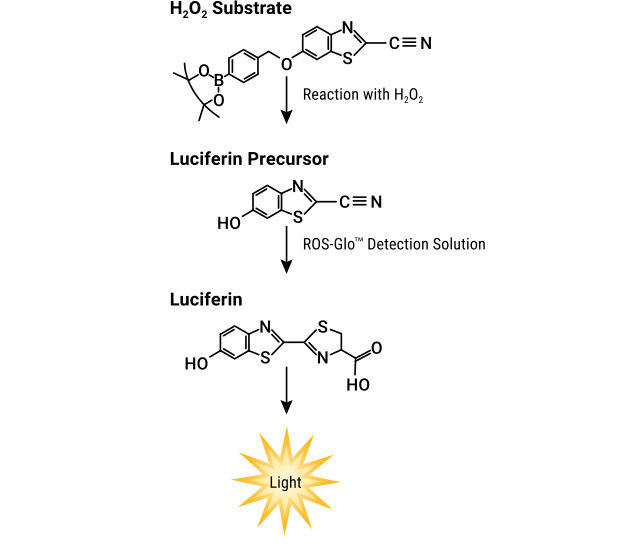
The H₂O₂ Substrate reacts directly with H₂O₂ to create the Luciferin Precursor. The ROS-Glo™ Substrate Detection Solution converts the Luciferin Precursor to luciferin and also provides the Ultra-Glo™ Luciferase to produce light. Light signal is proportional to the amount of H₂O₂ in the sample well.
Overview of the ROS-Glo™ H₂O₂ Assay Protocol for Cell-Based or Biochemical Detection
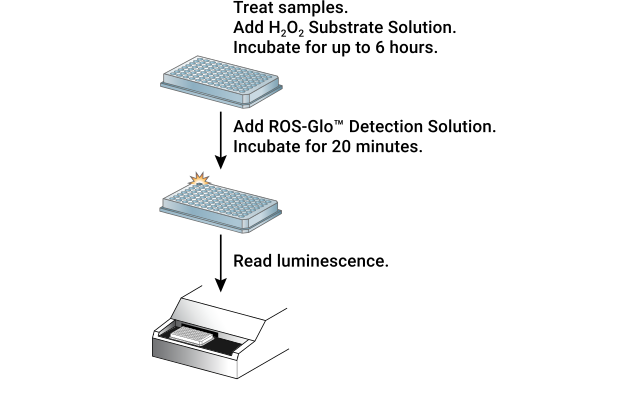
The assay follows a simple two-reagent-addition protocol that does not require sample manipulation. The ROS-Glo™ H₂O₂ Substrate can be added to assay wells with the treatment or at the end of the treatment incubation period, and data can be recorded in less than 2 hours after reagent addition.
Perform Enzymatic or Cell-Based Assays in 96- and 384-Well Plate Formats
ROS Induction in Cultured Cells
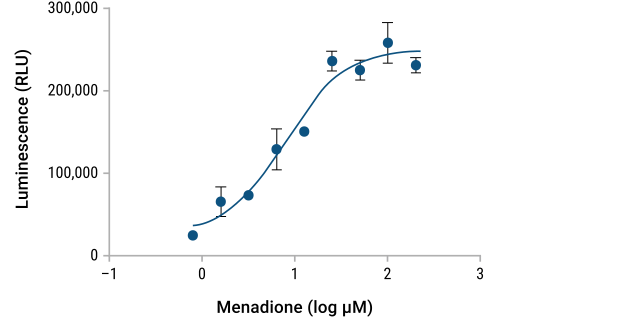
Menadione treatment of K562 cells resulted in a concentration-dependent ROS increase as detected with the ROS-Glo™ H₂O₂ Assay. The assay can be performed in various cell culture media with or without serum, eliminating the need to remove the media from cultured cells before performing the assay.
NADH Oxidase Enzymatic Activity
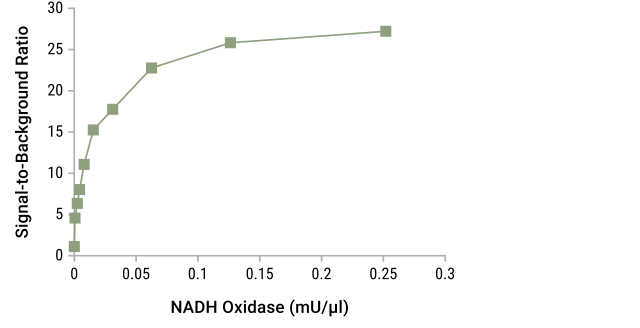
NADH Oxidase enzymatic activity was determined by incubating increasing concentrations of NADH oxidase with NADH in enzyme reaction buffer and measuring the H₂O₂ produced with the ROS-Glo™ H₂O₂ Assay. After appropriate levels of NADH oxidase and NADH substrate were determined, the assay was used to identify inhibitors of the enzyme in a chemical library by looking for decreased luminescence.
Multiplex With a Cytotoxicity Assay for More Informative Data Per Well
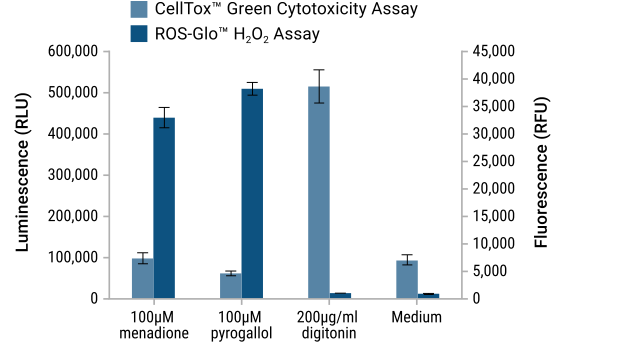
HepG2 cells were treated with either ROS-generating compounds (menadione or pyrogallol) or a cytotoxicity inducing reagent (digitonin) and incubated at 37°C for 2 hours. CellTox™ Green Dye (membrane impermeable DNA binding dye as an indicator of cytotoxicity) and H₂O₂ Substrate were added at the time of dosing. After incubation fluorescence from the CellTox™ Green Dye was measured followed by addition of ROS-Glo™ Detection Solution. Luminescence signal from the ROS-Glo™ Assay was measured following 20‑minute incubation.
Cat.# G8820 contains sufficient reagents for 100 assays at 100µl/assay in 96-well plates or 400 assays at 25µl/assay in 384-well plate format. Cat.# G8821 contains sufficient reagents for 500 assays at 100µl/assay in 96-well plates or 2,000 assays at 25µl/assay in 384-well plate format.
Case Study
Automated Assay Workflow for Mitochondrial Dysfunction
Challenge:
Louise Young, a research fellow at the University of Strathclyde, studies mitochondria’s role in Alzheimer’s and cancer. Her team needed a reliable, reproducible method to measure ROS output while screening compounds to decrease ROS levels. Traditional assays had wash steps, causing variability.
Result:
Using ROS-Glo™ H2O2 Assay, the team achieved faster turnaround with a no-wash protocol, greater reproducibility through luminescent readout and improved efficiency for quicker data collection.
Their workflow also includes RealTime-Glo™ Annexin V Assay for apoptosis/necrosis and CellTiter-Glo® 2.0 Assay for cell viability. Several compounds successfully reduced ROS, guiding future research into their protein targets.

Protocols
Complete Protocol
Protocolos Rápidos
Specifications
Catalog Number:
Contenido
| Item | Part # | Presentación |
|---|---|---|
H2O2 Substrate, 10mM |
G882A | 1 × 40μl |
Signal Enhancer Solution |
G883A | 1 × 100μl |
H2O2 Substrate Dilution Buffer |
G922A | 1 × 2ml |
d-Cysteine, 100X |
V251A | 1 × 100μl |
|
Luciferin Detection Reagent |
V859A | 1 × 1 each |
|
Reconstitution Buffer |
V865A | 1 × 10ml |
SDS
Search for SDSCertificado de Análisis
Use Restrictions
For Research Use Only. Not for Use in Diagnostic Procedures.Condiciones de Almacenaje
Contenido
| Item | Part # | Presentación |
|---|---|---|
H2O2 Substrate, 10mM |
G882B | 1 × 200μl |
Signal Enhancer Solution |
G883B | 1 × 500μl |
H2O2 Substrate Dilution Buffer |
G922B | 1 × 10ml |
d-Cysteine, 100X |
V251B | 1 × 500μl |
|
Luciferin Detection Reagent |
V859B | 1 × 1 each |
|
Reconstitution Buffer |
V865B | 1 × 50ml |
SDS
Search for SDSCertificado de Análisis
Use Restrictions
For Research Use Only. Not for Use in Diagnostic Procedures.Condiciones de Almacenaje
Resources
Artículos
Related Products
Productos Similares
GSH/GSSG-Glo™ Assay
Ensayo homogéneo para cuantificar el glutatión total y los ratios de glutatión.
V6611, V6612
GSH-Glo™ Glutathione Assay
Ensayo homogéneo y bioluminiscente para medir el glutatión.
V6911, V6912
Mitochondrial ToxGlo™ Assay
Un ensayo eficaz para predecir la posible disfunción mitocondrial.
G8000, G8001
Usado con frecuencia junto con
CytoTox-Fluor™ Cytotoxicity Assay
Ensayo fluorescente homogéneo de adición de un solo reactivo, que le permite medir el número relativo de células muertas en poblaciones celulares.
G9260, G9261, G9262
ApoLive-Glo™ Multiplex Assay
Mida la viabilidad y la actividad de la caspasa-3/7 de forma simultánea para confirmar los mecanismos de muerte celular.
G6410, G6411
CellTox™ Green Cytotoxicity Assay
Mide los cambios en la integridad de la membrana. Monitoriza cinéticamente la citotoxicidad hasta 72 horas y además tiene capacidad multiplex.
G8741, G8742, G8743, G8731
GloMax® Discover System
Lector de microplacas de alto rendimiento para la detección de luminiscencia, fluorescencia y absorbancia.
GM3000