cAMP-Glo™ Assay
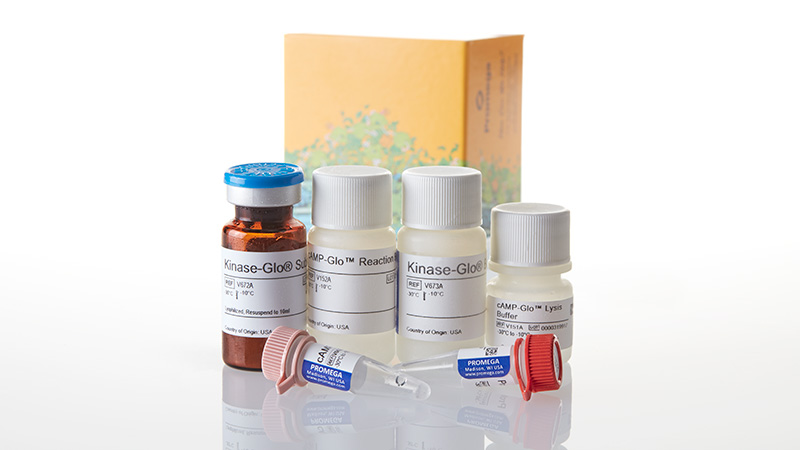
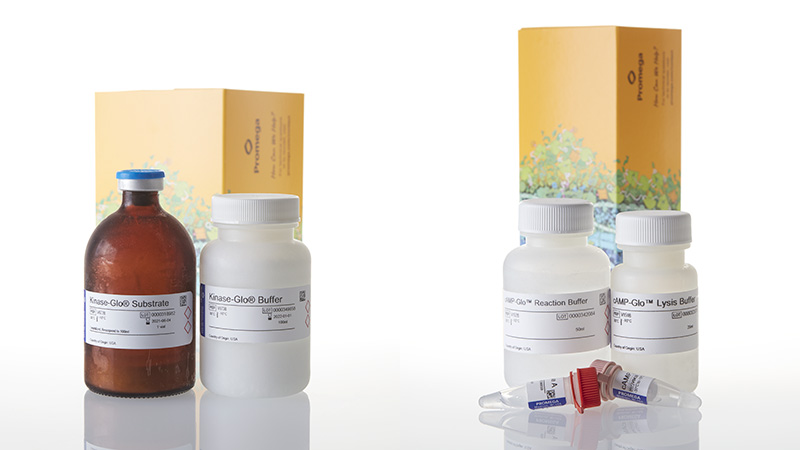
Simple, Bioluminescent cAMP Detection
- Complete in ~45 minutes
- Scalable to 1536-well plate formats and beyond
- No interference by fluorescent compounds

Catalog Number:
Size
Catalog Number: V1501
Catalog Number: V1502
Monitor Effect of Test Compounds on GPCRs
The cAMP-Glo™ Assay is designed to monitor cAMP production in response to the effects of test compounds on G protein-coupled receptors (GPCR). GPCRs that couple with adenylate cyclase will increase or decrease intracellular cAMP. The assay is based on the principle that cyclic AMP (cAMP) stimulates protein kinase A (PKA) holoenzyme activity, decreasing available ATP and leading to decreased light production in a coupled luciferase reaction.
The cAMP-Glo™ Assay can be performed in 96-, 384- or 1536-well plates. The cells are induced with a test compound for an appropriate period of time to modulate cAMP levels. After induction, cells are lysed to release cAMP, and then the cAMP detection solution, which contains protein kinase A, is added. Kinase-Glo® Reagent is then added to terminate the PKA reaction and detect the remaining ATP via a luciferase reaction. Plates are read using a microplate-reading luminometer. Luminescence can be correlated to cAMP concentrations using a cAMP standard curve. The half-life for the luminescent signal is greater than 4 hours. This extended signal half-life eliminates the need for luminometers with reagent injectors and allows batch-mode processing of multiple plates.
Cat.# V1501 contains sufficient reagents to perform 300 assays at 60μl final volume per well in 384-well plates.
Cat.# V1502 contains sufficient reagents to perform 3,000 assays at 60μl final volume per well in 384-well plates.
Excellent Signal:Background
The assay provides the best signal:background ratio of all the cAMP assays; signal:background >200 (with cAMP), >15 (on cells).Proven Luminescence Technology
Powered by Ultra-Glo™ Recombinant Luciferase, the bioluminescence-based cAMP-Glo™ assay provides a safe alternative to radioactive methods, and avoids the interference issues that can be problematic for fluorescence-based methods.
cAMP production in cells and the cAMP-Glo™ Assay.
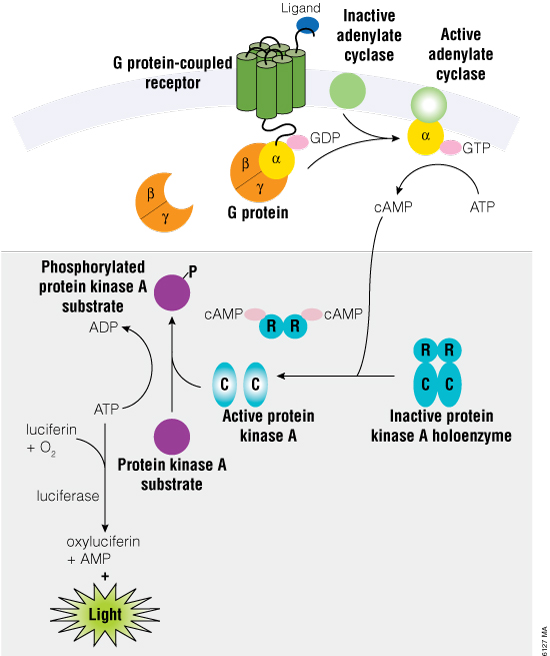
Representation of cAMP production in cells and the cAMP-Glo™ Assay.
Protocols
Complete Protocol
Protocolos Rápidos
Specifications
Catalog Number:
Contenido
| Item | Part # | Presentación |
|---|---|---|
|
Protein Kinase A |
V135D | 1 × 16μl |
|
cAMP-Glo™ Lysis Buffer |
V151A | 1 × 5ml |
|
cAMP-Glo™ Reaction Buffer |
V152A | 1 × 8ml |
|
cAMP, 1mM |
V642B | 1 × 100μl |
|
Kinase-Glo® Substrate |
V672A | 1 × 1 vial |
|
Kinase-Glo® Buffer |
V673A | 1 × 10ml |
SDS
Search for SDSCertificado de Análisis
Use Restrictions
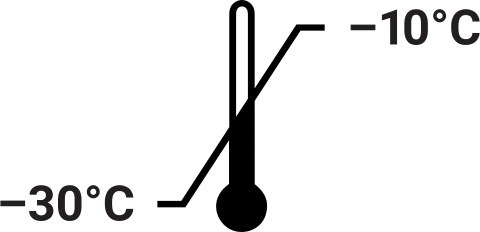
For Research Use Only. Not for Use in Diagnostic Procedures.Condiciones de Almacenaje
U.S. Pat. No. 7,700,310 and other patents and patents pending.
Contenido
| Item | Part # | Presentación |
|---|---|---|
|
Protein Kinase A |
V135C | 1 × 160μl |
|
cAMP-Glo™ Lysis Buffer |
V151B | 1 × 25ml |
|
cAMP-Glo™ Reaction Buffer |
V152B | 1 × 50ml |
|
cAMP, 1mM |
V642B | 1 × 100μl |
|
Kinase-Glo® Substrate |
V672B | 1 × 1 vial |
|
Kinase-Glo® Buffer |
V673B | 1 × 100ml |
SDS
Search for SDSCertificado de Análisis
Use Restrictions
For Research Use Only. Not for Use in Diagnostic Procedures.Condiciones de Almacenaje
U.S. Pat. No. 7,700,310 and other patents and patents pending.
Resources
Related Products
Productos Similares
cAMP-Glo™ Max Assay
Ensayo de alto rendimiento de 30 minutos para medir AMPc en células.
V1681, V1682, V1683
GloSensor™ Technology
Biosensores de células vivas para AMPc, GMPc o actividad de proteasas.
E1290, E1291, E2301, E1171
cAMP-Dependent Protein Kinase, Catalytic Subunit
Quinasa purificada para estudios de fosforilación de proteínas y transducción de señales.
V5161
Usado con frecuencia junto con
GloMax® Explorer System
Sistema de detección multimodo, flexible y fácil de usar.
GM3500, GM3510
GloMax® Discover System
Lector de microplacas de alto rendimiento para la detección de luminiscencia, fluorescencia y absorbancia.
GM3000
Kinase-Glo® Luminescent Kinase Assays
Determina la actividad de quinasas purificadas cuantificando el ATP restante tras una reacción quinasa.
V6711, V6712, V6713, V6714, V6071, V6072, V6073, V6074, V3771, V3772, V3773, V3774