LRRK2 Kinase Enzyme System

Easily Screen and Profile LRRK2 Kinase Inhibitors
- Includes kinase, substrate and reaction buffer
- Use with ADP-Glo™ Assay for bioluminescent detection of kinase activity

Catalog Number:
Size
Additional options
Catalog Number: V4474
Catalog Number: V6442
Catalog Number: V4475
Convenient, Scalable Kinase Profiling
The Kinase Enzyme Systems include a recombinant kinase enzyme, a substrate appropriate for the enzyme, a reaction buffer and supplemental reagents as needed. The LRRK2 Kinase Enzyme System contains:
- LRRK2 Kinase, 10μg (Human, recombinant; amino acids 968–end). MW: ~210kDa.
- LRRKtide (RLGRDKYKTLRQIRQ) Substrate.
- Reaction Buffer, DTT.
Recombinant human LRRK2 (968–end) was expressed by baculovirus in Sf9 insect cells using an N-terminal GST tag. LRRK2 or leucine-rich repeat kinase is a protein with an ankryin repeat region, a leucine-rich repeat (LRR) domain, a kinase domain, a DFG-like motif, a RAS domain, a GTPase domain, a MLK-like domain and a WD40 domain. Mutations in LRRK2 are the most frequent known cause of autosomal dominant and idiopathic Parkinson's disease with prevalent mutations being found within the GTPase and kinase domains. LRRK2 cooperates with MET to promote efficient tumor cell growth and survival in various cancers. Downregulation of LRRK2 in cultured tumor cells compromises MET activation and selectively reduces downstream MET signaling to mTOR and STAT3.
The LRRK2 Kinase Enzyme System can be purchased with or without the ADP-Glo™ Kinase Assay reagents. Used together, the ADP-Glo™ Kinase Assay + Kinase Enzyme Systems provide a convenient method for profiling the effect of lead compounds on kinase activity. Assay advantages include broad dynamic range, ease of use and high sensitivity. Kinase Enzyme Systems are manufactured by SignalChem. Bulk quantities available upon request.
Use with ADP-Glo™ Kinase Assay
The ADP-Glo™ Kinase Assay is a luminescent kinase assay that measures ADP formed from a kinase reaction; ADP is converted into ATP, which is a substrate in a reaction catalyzed by Ultra-Glo™ Luciferase that produces light. The luminescent signal positively correlates with ADP amount and kinase activity. The assay is well suited for measuring the effects of chemical compounds on the activity of a broad range of purified kinases, making it ideal for both primary screening as well as kinase selectivity profiling. The ADP-Glo™ Kinase Assay can be used to monitor the activity of virtually any ADP-generating enzyme (e.g., kinase or ATPase) using up to 1mM ATP.
See all Kinase Enzyme Systems available from Promega.
Specifications
Catalog Number:
SDS
Search for SDSCertificado de Análisis
Use Restrictions
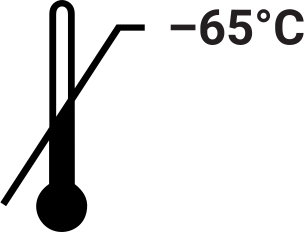
For Research Use Only. Not for Use in Diagnostic Procedures.Condiciones de Almacenaje
SDS
Search for SDSCertificado de Análisis
Use Restrictions
For Research Use Only. Not for Use in Diagnostic Procedures.Condiciones de Almacenaje
Contenido
| Item | Part # | Presentación |
|---|---|---|
| LRRK2 Kinase Enzyme System | V4474 | 1 × 10μg |
|
ADP-Glo™ Kinase Assay |
V9101 | 1 × 1,000 assays |
SDS
Search for SDSCertificado de Análisis
Use Restrictions
For Research Use Only. Not for Use in Diagnostic Procedures.U.S. Pat. No. 7,700,310 and other patents and patents pending.
U.S. Pat. No. 8,183,007 and other patents and patents pending.
Related Products
Productos Similares
Kinase Selectivity Profiling Systems—TK1, TK2, TK3, TK4
Tirosina quinasas y sustratos en formato de tira de 8 tubos optimizado para el análisis de perfil de quinasas.
V6850, V6851, V6852, V6853, V6920, V6921, V6922, V6923
MLK1 Kinase Enzyme System
Incluye quinasa, sustrato y tampón de reacción.
V4072, V6449, V4073
MLK2 Kinase Enzyme System
Incluye quinasa, sustrato y tampón de reacción.
V4476, V6450, V4477
RIPK2 Kinase Enzyme System
Incluye quinasa, sustrato y tampón de reacción.
V4084, V6478, V4085
Usado con frecuencia junto con
ADP-Glo™ Kinase Assay
Ensayo luminiscente universal de actividad quinasa.
V6930, V9101, V9102, V9103, V9104
ADP-Glo™ Max Assay
Detección luminiscente de la actividad ATPasa o quinasa.
V7001, V7002
GloMax® Navigator System
Luminómetro para microplacas.
GM2000, GM2010
GloMax® Explorer System
Sistema de detección multimodo, flexible y fácil de usar.
GM3500, GM3510